
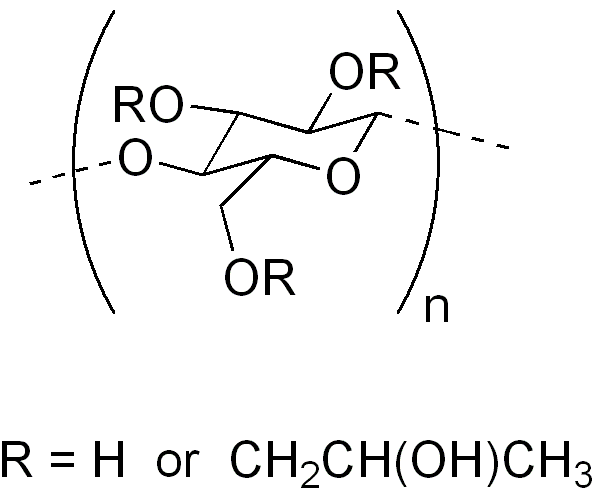
E463
E463 - Hydroxypropylcellulose
✅ Niveau de Risque: Sûr • Thickener/Stabilizer
À propos de cet additif
Origine
L'hydroxypropylcellulose (HPC) est un éther de cellulose non ionique soluble dans l'eau. Elle est dérivée de la cellulose, un polymère naturel que l'on trouve dans les parois cellulaires des plantes, généralement la pâte de bois ou les linters de coton. La cellulose est chimiquement modifiée en la faisant réagir avec de l'oxyde de propylène, introduisant des groupes hydroxypropyle le long de la chaîne cellulosique. Cette modification améliore sa solubilité dans l'eau et d'autres solvants.Utilisation
L'hydroxypropylcellulose est utilisée dans un large éventail d'applications en raison de ses propriétés épaississantes, liantes, filmogènes et stabilisatrices. Dans l'industrie alimentaire, elle sert d'épaississant, d'émulsifiant et de stabilisant dans divers produits alimentaires, notamment les sauces, les vinaigrettes, les desserts et les produits de boulangerie. Elle peut également être utilisée comme enrobage pour les comprimés et les gélules dans l'industrie pharmaceutique. En outre, elle trouve des applications dans les adhésifs, les matériaux de construction et les produits de soins personnels comme les shampoings et les lotions. L'HPC est également utilisée dans la production de formulations médicamenteuses à libération contrôlée.Effets secondaires
L'hydroxypropylcellulose est généralement considérée comme sûre pour la consommation. Le Comité mixte FAO/OMS d'experts des additifs alimentaires (JECFA) a établi une dose journalière admissible (DJA) « non spécifiée », indiquant que, sur la base des données disponibles, l'apport quotidien total de l'additif alimentaire ne représente pas un danger pour la santé. Cependant, comme d'autres dérivés de la cellulose, une consommation excessive peut entraîner des inconforts gastro-intestinaux, tels que des ballonnements ou de la diarrhée, chez les personnes sensibles. Les réactions allergiques sont rares mais possibles. Des organismes de réglementation comme l'EFSA et la FDA ont approuvé son utilisation dans les aliments sous des conditions et limitations spécifiques.Sources
- 📚 EFSA 2018
- 📚 FDA CFR 21
- 📚 JECFA
Informations Rapides
Type
Thickener/Stabilizer
Niveau de Risque
✅ Sûr
Végane?
✅ Oui
Halal?
✅ Oui