
E553AII
E553aii - Trisilicate de magnésium
✅ Niveau de Risque: Sûr • Additive
À propos de cet additif
Origine
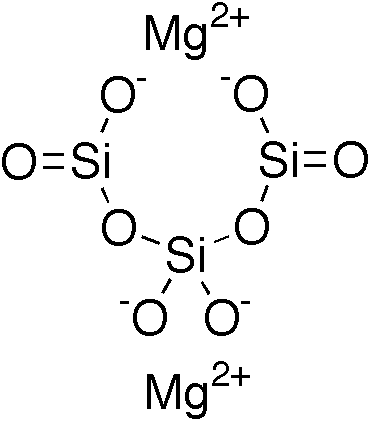
Le trisilicate de magnésium est un sel inorganique composé d'oxyde de magnésium et de dioxyde de silicium. Il existe naturellement sous forme de minéral, la sépiolite, mais l'additif de qualité alimentaire est généralement synthétisé. La production synthétique garantit la pureté et la constance pour son utilisation dans les applications alimentaires et pharmaceutiques. C'est une poudre fine, blanche et inodore.Utilisation
Dans l'industrie alimentaire, le trisilicate de magnésium est principalement utilisé comme agent anti-agglomérant pour empêcher les aliments en poudre ou granulaires de s'agglomérer. Il peut également servir d'auxiliaire de filtration. Ses propriétés absorbantes le rendent utile pour clarifier les liquides. On le trouve dans une variété de produits, y compris le sel de table, le lait en poudre, les épices et les préparations pour pâtisserie. Il est également utilisé dans les antiacides en raison de sa capacité à neutraliser l'acide gastrique.Effets secondaires
Le trisilicate de magnésium est généralement considéré comme sûr pour la consommation aux niveaux typiquement utilisés dans les aliments. Le Comité mixte FAO/OMS d'experts des additifs alimentaires (JECFA) a établi une dose journalière admissible (DJA) « non spécifiée », ce qui signifie que, sur la base des données disponibles, l'apport quotidien total de la substance résultant de son utilisation aux niveaux nécessaires pour obtenir l'effet désiré et de son apport de fond acceptable dans les aliments, ne représente pas un danger pour la santé. Cependant, une consommation excessive de trisilicate de magnésium peut entraîner des problèmes gastro-intestinaux, tels que la diarrhée. Les personnes souffrant de problèmes rénaux doivent faire preuve de prudence, car le magnésium peut s'accumuler dans le corps. Aucune réaction allergique significative n'est associée au trisilicate de magnésium.Statut réglementaire
Le trisilicate de magnésium est approuvé comme additif alimentaire dans de nombreux pays, y compris les États-Unis, l'Union européenne et le Canada. Les réglementations spécifient les niveaux maximaux autorisés dans diverses catégories d'aliments. Dans l'UE, il est désigné sous le nom E553a(ii). La FDA l'inclut dans sa liste de substances généralement reconnues comme sûres (GRAS) lorsqu'il est utilisé conformément aux bonnes pratiques de fabrication.Sources
- 📚 JECFA
- 📚 FDA CFR 21
- 📚 EFSA
- 📚 Wikipedia
- 📚 PubChem
Informations Rapides
Type
Additive
Niveau de Risque
✅ Sûr
Végane?
✅ Oui
Halal?
❓ Peut-être
Additifs Associés
E452III
Sûr
E452iii - Polyphosphate de sodium-calcium
E333II
Sûr
E333ii - Citrate dicalcique
E452IV
Sûr
E452iv - Polyphosphate de calcium
E331III
Sûr
E331iii - Citrate trisodique
E470AII
Sûr
E470aii - Sels de potassium d'acides gras
E905F
Prudence
E905f - Huile minérale de viscosité moyenne et faible classe II